Focus on Chemistry, Materials & Life Sciences
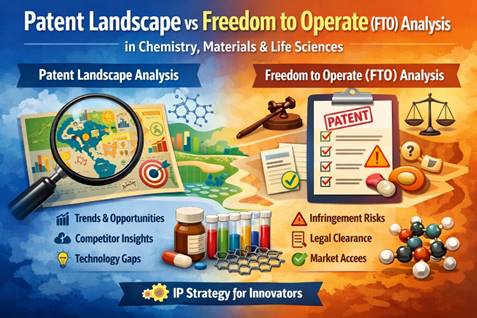
If you build in chemistry, materials, biotech, medtech, or pharma, patents are not just “legal stuff.” They are technical constraints that can shape (or sink) your R&D roadmap and your go-to-market plan. Two tools are used constantly—often confused, sometimes misused:
- IP / patent landscape analysis = “What’s happening in this technology space, who owns what, and where are the opportunities and choke points?”
- Freedom-to-operate (FTO) analysis = “Can we make/use/sell THIS specific product/process in THIS country without stepping on an enforceable patent?”
A landscape is a map. FTO is checking whether your specific route crosses private property. And yes, you can own a patent and still be blocked. That’s not a paradox; it’s normal in patents.
1) Patent landscape analysis: your strategic radar (broad, pattern-based)
What it is (in practice)
A patent landscape is a structured review of patent publications in a defined technical field to show:
- who is filing,
- what sub-topics are crowded,
- where “white space” exists,
- where patents cluster into potential bottlenecks, and
- how the field is moving over time.
It’s typically used before you fully commit: concept stage, platform selection, partner scouting, investor due diligence.
What you actually get value from (not the fluff)
A good landscape should answer questions founders and R&D leads actually have:
A. “Where are we likely to get blocked later?”
Not a full infringement opinion—but it can flag sub-areas where one or two players dominate (potential future licensing pain).
B. “Who should we partner with, license from, or avoid?”
Landscapes reveal “silent” players you didn’t know existed (subsidiaries, universities, stealth startups).
C. “Where is there room to build defensible IP?”
White space is rarely “no patents.” More often it’s “few patents in this mechanism, formulation family, process window, or application niche.”
Chemistry/materials/life science wrinkles that make landscapes harder
- Chemical naming chaos: keyword searching alone fails; you need structure/Markush-aware searching for many chemistry domains.
- Platform tech overlaps: in biotech/medtech, patents may sit on enabling tools (vectors, promoters, assays, delivery devices) rather than your headline “product.”
- Process claims matter: in chemicals/materials, the “product” may be free, but a scalable manufacturing route may be locked. (A landscape should map both composition and process clusters.)
“Real-life” style example (competitor & investor reality)
Companies routinely use landscapes for competitor monitoring and to spot previously unknown entrants; professional reports often add clustering/visualization that internal teams don’t have time to build.
2) Freedom-to-operate (FTO): your commercialization clearance (narrow, claim-based)
What it is (in practice)
An FTO assesses whether your specific product/process would likely infringe any in-force patents in the countries you care about, by comparing your technical features to patent claims.
FTO is typically done:
- before scale-up,
- before major partnering/licensing,
- before clinical/commercial milestones,
- before entering new geographies.
Why it’s especially critical in life sciences
The economics are brutal: late-stage failure can destroy enormous sunk costs, and patent disputes can trigger injunction risk and high damages in some jurisdictions.
(Translation: you want to find out you have a patent problem when changing your process is still cheap.)
What FTO is not
- It is not “we didn’t find anything on Google Patents.”
- It is not “we have our own patent, therefore we’re safe.” Patents don’t grant a right to practice; they grant a right to exclude others.
What “good” FTO looks like in science-heavy fields
Step 1 — Freeze a product/process definition
For pharma/biotech this includes: structure/sequence, formulation, manufacturing, use, device (if any). For materials: composition ranges, additives, process conditions, end-use constraints.
Step 2 — Jurisdiction scoping
Patents are territorial: being clear in Germany doesn’t clear you in the US (and vice versa).
Step 3 — Search + shortlist
Search is technical; analysis is legal. The high-risk mistake is treating it as “just searching.”
Step 4 — Claim-by-claim comparison
This is where non-lawyers routinely go wrong: infringement risk turns on claim language, definitions, and interpretation.
Step 5 — Risk handling plan
Common outcomes:
- Design-around (change composition/process/feature)
- License / cross-license
- Challenge validity (EU opposition; US PTAB options)
- Market sequencing (launch where clear first; expand later)
Concrete example (the “we patented it!” trap)
You develop an improved formulation/delivery of an existing active ingredient. You can patent the improvement—yet still be blocked by a broader patent on the active or core platform. That scenario is so common it’s practically a rite of passage in pharma.
3) Landscape vs FTO: the shortest useful comparison
| Topic | Landscape | FTO |
| Core question | “What’s going on in the field?” | “Can we sell this without infringing?” |
| Scope | Broad | Narrow but deep |
| Main output | Trends, players, clusters, whitespace | Patent-by-patent risk positions + mitigation |
| Timing | Early + ongoing | Pre-commercial milestones + updates |
| Biggest failure mode | Missing key players / mis-scoping | Misreading claims / false comfort |
If you remember just one line: Landscape helps you choose the game; FTO helps you avoid losing by disqualification.
4) Europe vs US: differences that change how you manage risk
Territorial rights (the universal rule)
A US patent is irrelevant in Europe for enforcement, and vice versa—so FTO must match the actual countries you operate in.
Enforcement and procedural realities
- Europe: historically enforced country-by-country; now the Unified Patent Court (UPC) can create broader multi-country effects for participating states (material for enforcement strategy and risk).
- Europe: centralized EPO opposition can knock out or narrow a patent relatively efficiently (if timing fits).
- US: PTAB proceedings (e.g., IPR) are a major validity-challenge tool; US damages exposure and “willfulness” dynamics make documentation and counsel involvement particularly important.
(You do not need to become an expert in these procedures—but you do need counsel who is.)
5) “Make it work” playbooks for startups and R&D teams
A. The “Platform/technology selection” playbook (landscape-led)
Use a landscape to:
- identify crowded subspaces (avoid head-on fights),
- locate whitespace or underprotected niches,
- shortlist partners/targets for licensing or collaboration.
B. The “Pre-scale-up” playbook (FTO-led)
Before you lock manufacturing:
- do an FTO targeted to the actual production route and composition windows,
- prioritize highest-risk jurisdictions first (often EU+US),
- build design-around options into development early.
C. The “Investor due diligence” playbook (both)
Investors typically want:
- evidence you understand the competitive IP landscape, and
- evidence you have an FTO risk plan (not necessarily “perfect freedom,” but a defensible approach).
6) Pros and cons (objective, not marketing)
Patent landscape analysis
Pros
- Guides R&D direction and partnering
- Finds hidden competitors and patent clusters
- Helps avoid investing in dead-end subspaces
Cons
- Can be expensive if overbroad
- Easily becomes “pretty charts” without decisions
- Not an infringement clearance (people misuse it as one)
FTO analysis
Pros
- Directly reduces launch and litigation risk
- Enables design-around and licensing plans early
Cons
- Can’t guarantee zero risk (new filings, claim scope changes)
- Cost grows with jurisdictions and product complexity
- A weak FTO is worse than none, because it creates false confidence
7) The repeated but necessary message: why IP specialists matter
- Only qualified IP professionals can reliably turn patent documents into a business-safe decision, because the risk turns on claim scope, legal interpretation, and jurisdiction-specific enforceability.
- In chemistry/biotech, search quality depends on specialist tools and specialist know-how (Markush/structure/sequence), and non-expert searching commonly misses the very patents that matter most.
- An IP specialist does not merely “search patents.” They design the scope, interpret the claims, and build an actionable risk plan (design-around, licensing, challenges). That is where value is created.
If you want a one-liner: Landscapes and FTO are too important to be treated as “a quick search task.”
Fun fact
Patent language is so creative that two patents describing the same chemical concept may share almost no keywords—one reason why chemical/biotech searching is its own sport. Your lab notebook is honest; patent prose is… strategically verbose.
 Home
Home 
Leave a Reply