Focus on for Chemistry, Materials & Life Sciences
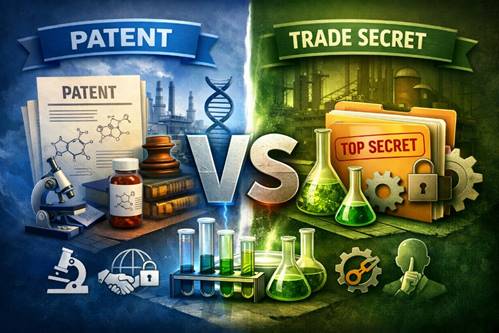
You have an invention. You also have limited time, budget, and patience for legal theory. The real question is: Should you disclose and patent it, or keep it secret and rely on trade secret protection? In chemistry/materials/life sciences, the answer is usually driven by two brutally practical issues:
- Can competitors figure it out (reverse engineering or regulation disclosure)?
- Do you need enforceable exclusivity to attract funding or block copycats?
Below is a shortened, Europe-focused decision guide with concrete examples and citations.
The core trade-off in one sentence
- Patent: disclose it publicly, get a time-limited right to stop anyone using it.
- Trade secret: keep it confidential, potentially forever — but you generally cannot stop independent discovery or reverse engineering.
(That second point is where many “we’ll just keep it secret” strategies go to die.)
What matters most in chemistry/materials/life sciences
1) Reverse engineering: “Can they figure it out from the product?”
If the answer is yes, trade secrets are usually weak.
Common “easy to reverse engineer” scenarios
- Small molecules, formulations, polymers, catalysts sold as products (advanced analytics are routine).
- Consumer products where composition can be inferred by testing.
Common “hard to reverse engineer” scenarios
- Industrial processes inside a plant (process conditions, sequencing, know-how).
- Manufacturing parameters (e.g., impurity control, crystallization protocol) not evident from the product.
- Complex multi-step workflows where knowing the ingredients isn’t enough.
Why this matters: trade secret law generally targets misappropriation (theft, breach of confidence), not legitimate reverse engineering or independent invention.
2) Regulatory disclosure: “Will you have to reveal it anyway?”
Life sciences can force disclosure.
- If approval/labeling requirements mean your invention becomes knowable (e.g., drug active ingredient), trade secret protection for the core invention is often unrealistic.
- Patents are commonly used precisely because secrecy collapses under regulatory reality.
3) Enforceability: “Can you actually police it?”
- Patents: you enforce by showing the competitor is practicing what you claimed (often clearer).
- Trade secrets: you enforce by proving (a) it was a real secret, (b) you protected it reasonably, and (c) they obtained it improperly. This can be evidentially heavy, especially in process-heavy industries.
4) Commercial reality: “Do you need investors/partners?”
In many deep-tech and life-science deals, patents are the “standard currency” because they’re a transferable, auditable asset. Trade secrets can be valuable too, but investors often discount them unless the company demonstrates robust controls and low leakage risk.
Patent vs Trade Secret: Practical pros/cons (science-focused)
Patents tend to be better when…
- The product can be analyzed (composition/structure will be discovered anyway).
- You plan licensing, partnering, or fundraising where a clear IP asset matters.
- You need a credible deterrent against copycats in multiple jurisdictions.
- The competitive risk is “they’ll copy what we sell,” not “they’ll steal our internal know-how.”
Main downside: you publish. Competitors can learn (and design around), and the protection is time-limited.
Trade secrets tend to be better when…
- The key value is in process know-how or “how we do it” internally.
- Reverse engineering is impractical, and you can implement strong secrecy controls.
- Your innovation is incremental but commercially critical (e.g., yield improvement, stability trick, purification sequence) and you don’t want to educate rivals.
- The business plan is “we manufacture and sell,” not “we broadly license the tech.”
Main downside: if someone figures it out independently or through lawful reverse engineering, you generally cannot stop them — and if the secret leaks publicly, the protection can evaporate.
Concrete examples (chem/materials/life sciences)
Example A: New small-molecule drug candidate
Best fit: Patent (for the core compound/use) + trade secrets for manufacturing know-how.
Why: regulatory and product analysis make secrecy fragile for the core. Process details (scale-up, impurity control) can often remain know-how.
Example B: Industrial catalyst made in-house and never sold as a standalone product
Often best fit: Trade secret (especially for preparation/activation + operating conditions).
Why: if competitors can’t access samples or replicate performance without your full process conditions, secrecy can outlast any patent term.
Example C: Materials coating formulation sold to customers
Often best fit: Patent (or at least patent the key differentiator).
Why: coatings and formulations are frequently characterized by competitors; once discovered, a trade secret offers limited leverage against legitimate reverse engineering.
Example D: Fermentation process with proprietary strain + process parameters
Best fit (frequently): Hybrid
- Patent aspects that are hard to keep secret once commercialized (e.g., product, certain uses).
- Keep strain handling, media tweaks, feed strategy, and scale-up parameters as trade secrets.
Why: competitors may replicate outcome only with deep know-how; secrecy can preserve a “practical gap” even after patents expire.
Europe-focused legal anchor points
- In the EU, trade secret protection is harmonized by the Trade Secrets Directive (EU) 2016/943, which centers on unlawful acquisition/use/disclosure and requires “reasonable steps” to keep the info secret.
- Globally, trade secret concepts are also reflected in TRIPS standards (confidential, commercially valuable, reasonable steps).
- Patent regimes (EPO/European patents; national enforcement) provide exclusionary rights but require publication.
Decision checklist (fast and usable)
If you answer “yes” to any of these, you’re usually in patent territory:
- Will the product be sold and analyzable?
- Will regulation or customer requirements force disclosure?
- Do you need investor-friendly IP?
- Would a competitor copying you cause immediate existential pain?
If you answer “yes” to these, trade secret is often strong:
- Is the value in an internal process?
- Is reverse engineering impractical?
- Can you enforce strong confidentiality (NDAs, access controls, segmentation of know-how)?
- Are you comfortable with the risk that someone might lawfully figure it out?
A sensible “middle path” most science companies use
Patent the parts that will be exposed. Keep the rest as know-how.
This is common in life sciences and advanced materials: patents for the core protectable concept; trade secrets for the messy real-world details that make it work at scale.
 Intellectual Property & Technology Services for Startups | Dr. Alexander Lygin
Leave a Reply